
Support Materials:
A Tasmanian Requiem
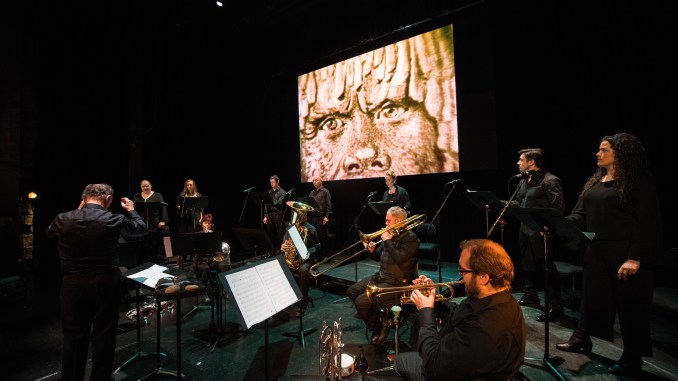
Short extracts from work
Lyrics:
And when the mourning is over
what can we do?
We offer tagari-lia (family)
Lyrics:
Asperges (purge)
Ossa humiliata (humbled bones)
projicias (cast/eject)
holocaustis (burnt offerings)
Praise for A Tasmanian Requiem
Limelight Magazine
Three years in the making, this 83-minute oratorio for voice and brass shares the history of the Black War. In an opening address, it is made very clear that this requiem was not created to entertain. Its intention is to allow us space to grieve for lives destroyed; for an Indigenous population that lost more than 90 per cent of its people in the two decades after British arrival on Van Diemen’s Land.
… Not only does it force us to remember, but it educates those of us who cannot remember what has been kept silent, the stories that have been buried rather than taught to our children. This work is dark and monumental. In A Tasmanian Requiem, this state has found a true masterpiece.
Read more
Tasmanian Times
A Tasmanian Requiem acknowledges the pain of two cultures torn hideously apart and then dares to weave threads of compassion between them. The tragedy and complexity are magnificently expressed in this inspired collaborative work of genius.
Read more
The Conversation
This deeply moving performance could be viewed as an act of symbolic and practical reconciliation, given the Aboriginal and non-Aboriginal artists and audience members. It examined the pre-colonial and colonial past while offering a road map towards a reconciled future.
Read more
CutCommon Magazine
Forged as a collaborative work between composer [Quin] Thomson and writers Greg Lehman, Frances Butler, and Jim Everett-puralia meenamatta, A Tasmanian Requiem references a traditional Latin mass for the dead; while taking a more contemporary approach of using this form to acknowledge and grieve for a colossal human tragedy.
… Fusing mid-20th Century dissonant harmony with textures and forms found in early sacred music, Thomson’s rich musical palette creates a level of expression that matches the depth and pathos of the text. At times, [their] use of cluster harmony and micro-polyphony are reminiscent of Ligeti’s Requiem from the mid-1960s.
All vocalists are outstanding in their roles as soloists, or as part of the ensemble. A clarity of vocal production throughout the work reflects a significant investment in the singers’ preparation time.
Read more
Credits
Performers:
Island Brass Quintet
Madelena Andersen-Ward
Zoy Frangos
Quin Thomson
Amelia Jones
Tom Buckmaster
Stephen Grant
Lotte Betts-Dean
Musical Director / percussion: Gary Wain
Music: Quin Thomson
Visual materials: Julie Gough and Michael Gissing
Libretto:
Gregory Lehman
Jim Everett / puralia meenamatta
Frances Butler
Production: Gap in the Fence